
Anode Basket Selection: The Hardware Decision That Affects Deposit Uniformity
Why Anode Geometry Matters
The anode basket is one of the most consequential — and most frequently underspecified — components in a plating tank. Its job is to hold the soluble anode material (zinc balls, copper rounds, nickel rounds) in a geometry that produces uniform current distribution across the cathode work. When that geometry is wrong — wrong basket dimensions, wrong positioning relative to the cathode, wrong material for the chemistry — the consequences show up as deposit thickness variation that can be difficult to trace back to its source.
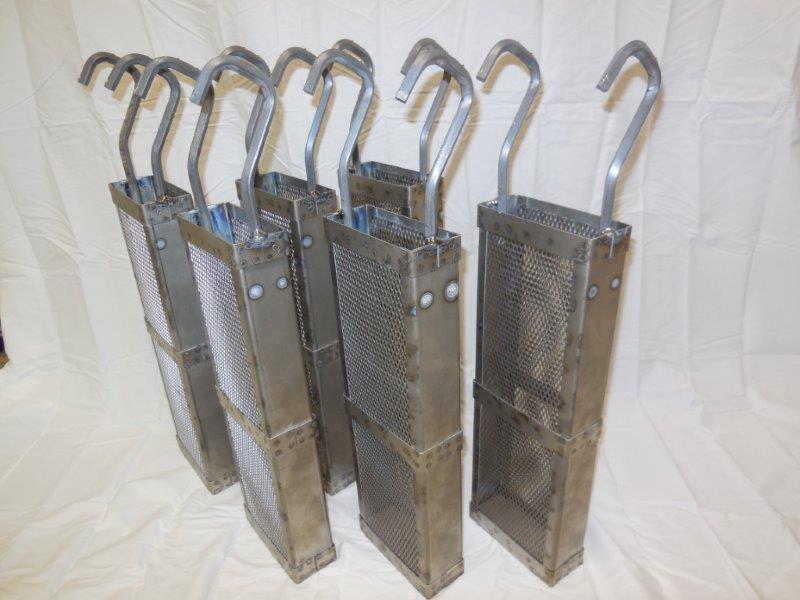
Current flows from anode to cathode along paths of least resistance. An anode basket positioned too close to one end of the tank, or one that's run half-empty because the replenishment schedule isn't keeping up, produces current distribution that favors the nearest cathode surface. The result is non-uniform deposit — consistently, until someone repositions the anode or changes the fill protocol.
Titanium vs. Stainless Steel Baskets
Titanium is the correct material for soluble anode baskets in alkaline zinc, zinc-nickel, and copper plating systems. Here's why: titanium forms a stable, passive oxide layer in these chemistries that is electrically conductive but chemically inert. It doesn't dissolve, contaminate the bath, or corrode at the anode potential. Stainless steel, by contrast, is anodically active in many plating chemistries — it will corrode at the anode and introduce iron and chromium contamination into the bath over time.
Stainless steel baskets are appropriate for some nickel plating applications and for certain passive anode configurations (where the basket itself carries current but the anode material is insoluble platinum, MMO, or similar). For zinc systems specifically, titanium is the standard — and the cost premium over stainless is modest relative to the risk of bath contamination from the wrong material.
For highly aggressive acid chemistries — bright copper in sulfuric acid, some acid zinc systems — specialty alloys including zirconium, tantalum, or Hastelloy may be required. The correct material depends on bath chemistry, temperature, and current density. When in doubt, ask for a material compatibility evaluation before specifying.
Ball vs. Rectangular Baskets
Ball-style anode baskets (loose zinc or copper balls in a perforated titanium cage) are the most common configuration for barrel zinc plating. They offer flexible fill management — you add balls as the anode depletes — and the spherical geometry of the balls provides good current distribution from the basket surface. Mesh or perforated basket designs are alternative configurations with different current distribution characteristics.
Rectangular baskets are used where tank geometry requires a specific anode profile, or where plate-style anodes are preferred over ball material. The right choice depends on your tank dimensions, the anode-to-cathode distance your process requires, and the specific chemistry you're running.
Sizing the Basket
Anode basket sizing affects both current distribution and anode utilization efficiency. An anode surface area that's too small relative to cathode area forces the available anode material to carry high current density — accelerating dissolution and producing non-uniform current distribution. A common rule of thumb for barrel zinc: anode-to-cathode area ratio of 1:1 to 2:1, with anode baskets positioned to provide uniform coverage of the barrel's sweep path through the bath.
Anode height relative to the cathode work zone matters as well. An anode basket that doesn't extend to the full depth of the cathode work zone produces a vertical current gradient — parts near the top of the barrel plate thicker than parts at the bottom, or vice versa. This is a geometric problem that no amount of chemistry adjustment will solve.
Heating and Cooling Coils
While not an anode component, heating and cooling coils are specified and fabricated by the same specialty metal manufacturers, and the material selection logic is identical. In alkaline zinc baths at 60–65°C, titanium coils are the correct choice — they handle the bath chemistry and temperature without corrosion or contamination. For aggressive acid pickle baths (HCl, H₂SO₄), Hastelloy or tantalum may be required. For ambient-temperature rinse tanks, stainless steel is typically sufficient.
Coil sizing is a heat transfer calculation based on bath volume, target temperature range, available utilities (steam vs. hot water vs. electric), and bath heat generation from electrolysis. An undersized coil can't hold bath temperature in cold weather; an oversized coil with poor control creates temperature spikes. See pH, ORP, and Amp Hours for why bath temperature control is part of consistent process monitoring.
When to Evaluate Your Current Anode Setup
Anode geometry and material are worth reviewing if you're seeing: unexplained deposit thickness variation from position to position in the tank; bath contamination that tracks with no obvious chemistry source; anode material that depletes unevenly or at unexpected rates; or hardware that's more than 8–10 years old in an aggressive chemistry environment. Any of these symptoms can trace back to anode configuration.
American Metal & Coil Works manufactures titanium anode baskets, heating and cooling coils, and custom fixtures in specialty alloys including Ti, Zr, Hastelloy, Monel, SS316, tantalum, and niobium. Tell us your tank dimensions, chemistry, and current configuration and we'll specify the right hardware.
Inquire About Anode Hardware →