Smallest Part, Biggest Decision: How Part Size Drives Barrel Perforation Choice
The Single Decision That Drives Perforation Choice
When customers ask which perforation pattern to spec on a new barrel — round hole, C-slot, straight slot, or custom CNC — the most useful question to ask back is: what is the smallest part you plate? Not the average part. Not the most common part. The single smallest part. That part's dimensions, multiplied by a margin for orientation and tumble, set the maximum hole size the barrel can use without losing parts to the bath floor.
Open area, drag-out reduction, and current-density distribution all matter — and our companion article "C-Slot vs. Round Hole vs. Straight Slot" covers those tradeoffs in depth. But the perforation pattern is bounded above by part-escape risk, and that bound is set by the smallest part. Get the smallest-part analysis right and the rest of the perforation decision becomes straightforward.
Why "Open Area" Isn't the Whole Answer
The temptation in barrel specification is to maximize open area. More open area generally means faster fill and drain times, less drag-out, lower energy consumption, and shorter cycle times (see Why Barrel Open Area Matters). All other things equal, more open area is better.
All other things are not always equal. A barrel with maximum open area is also a barrel with maximum part-escape risk. If the perforation hole is larger than the smallest part's controlling dimension, parts will fall through during tumble — and the cost of recovering, sorting, and re-running one lost batch can erase a year's worth of optimized-perforation savings. The right framework: maximize open area subject to the constraint that no part can pass through.
Round Hole — Maximum Part Retention
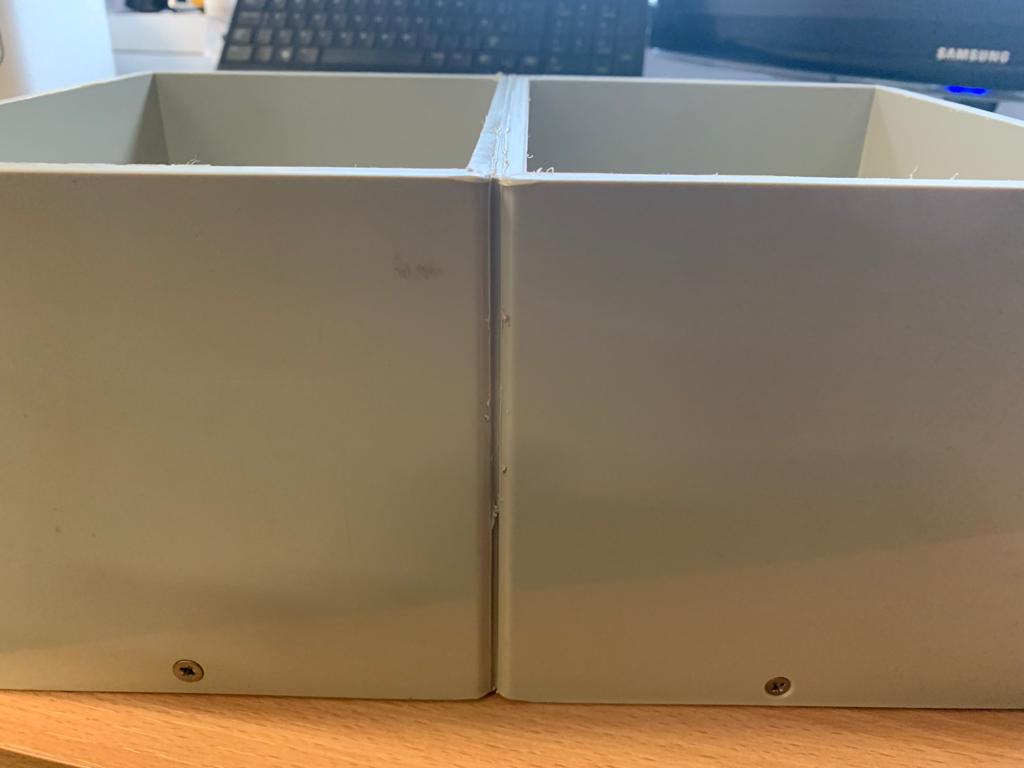
Round-hole perforation is the safest pattern for part-escape risk. The retention dimension is the hole diameter, which is the same in every direction. A round hole of 5mm diameter will retain any part with at least one dimension greater than 5mm in any orientation.
This makes round-hole perforation the right choice when: (1) you plate small parts where escape risk is critical (M3 or smaller fasteners, small electronic contacts, watch components); (2) your part geometry varies widely and you can't predict orientation; (3) the production line runs unattended for long periods and a part-escape event would not be discovered quickly.
The cost is open area. Round-hole patterns max out around 11–18% open area depending on hole spacing. C-slot and straight slot patterns reach 22–28% open area at equivalent retention dimensions. Round hole is the conservative, low-risk choice.
C-Slot — The Open Area Compromise
C-slot perforation uses curved slots arranged in a pattern that prevents parts from aligning with the slot direction. Because parts can't align, the retention dimension is effectively the slot width (not the slot length). This means C-slot patterns can have a larger total slot area while maintaining the same retention as a smaller round hole.
C-slot is Eagle's most popular pattern for several reasons: it provides 22–26% open area on most barrel sizes, it works for the majority of zinc plating part geometries (fasteners, small castings, stamped components), and the curved slot geometry resists the gradual deformation that affects straight slots over time. For typical zinc operations plating M5-and-larger fasteners, C-slot is the default recommendation.
The C-slot constraint: parts that are very long and very thin (wire forms, pins) can sometimes align with the slot direction during slow tumble and slip through. If your line plates wire forms or thin pins, verify with a sample piece on a C-slot panel before committing.
Straight Slot — Highest Drag-Out Reduction
Straight slot perforation provides the highest open area per square foot — typically 26–28% — and the fastest drainage characteristics. Liquid drains through the slots faster than through round holes or C-slots because there's less surface to climb against during drainage.
Straight slot is appropriate when: (1) drag-out reduction is the primary economic driver (high-cost chemistry, environmental considerations); (2) all parts in the load have a controlling dimension significantly larger than the slot width; (3) production volumes are high enough that small percentage improvements in drag-out add up to meaningful savings.
The constraint is part orientation. Long thin parts can align with the slot and slip through. Most operations using straight slot also use load filtering — pre-screening parts to remove anything below a minimum size — to manage this risk.
Custom CNC — When None of the Standards Work
For very small parts, irregular part geometries, or applications where standard patterns don't provide acceptable retention plus open area, Eagle can CNC-cut custom perforation patterns. The most commonly used custom pattern is a "moon-shape" — a curved slot that's narrow at one end and wider at the other — which provides part retention against multiple orientations while delivering moderate open area.
Custom CNC perforation is significantly more expensive than standard patterns. A single barrel with custom moon-shape pattern requires roughly 23 machine hours of CNC time at Eagle's facility, versus 4–6 hours for a standard round-hole pattern. Custom CNC is therefore reserved for applications where the part economics justify the tooling cost: typically high-value small parts (precision fasteners, electronic components, medical device components) where the alternative is significant scrap loss.
The Smallest Part Geometry Test
Here is the analysis sequence: (1) Identify the smallest part in your typical load. (2) Measure its three dimensions: length × width × height (or, for cylindrical parts, diameter × length). (3) Identify the smallest of those dimensions. This is the controlling dimension. (4) Set the maximum perforation hole size to roughly 80% of the controlling dimension. The 80% factor accounts for orientation variation during tumble. (5) Choose the perforation pattern that maximizes open area while staying within that hole-size limit.
Example: an M6 hex nut has dimensions roughly 10mm (across flats) × 11mm (corner-to-corner) × 5mm (height). The controlling dimension is 5mm (height). 80% of 5mm = 4mm maximum hole size. A round-hole pattern at 4mm provides about 13% open area. A C-slot pattern at 4mm slot width provides about 24% open area. Both retain the part safely; C-slot wins on efficiency.
Mixed Loads
If your line plates a wide range of part sizes, the perforation has to be sized to retain the smallest — even if the smallest is rare in production volume. Two strategies: spec the barrel for the smallest part and accept reduced open area on the larger ones, or run dedicated barrel sets for different part-size families. The first is simpler and often the right call; the second optimizes perforation per family but requires scheduling discipline and extra barrel inventory.
Custom Patterns
If standard patterns won't provide acceptable retention and acceptable open area, Eagle can design custom perforation. The process generally involves submitting smallest-part dimensions (and a sample part if possible), reviewing a proposed pattern with calculated open area and retention, and — for borderline cases — testing on a prototype panel before committing to the production order. Custom patterns add to lead time and cost, so they're worth the investment when part-escape losses or drag-out costs are significant operational concerns.
Have parts smaller than 5mm in any dimension? Send a sample part along with the controlling dimensions through the contact page or to info@levelupplatingsupply.com, and we'll work with Eagle to recommend a perforation pattern.
Request a Perforation Recommendation →