Why PE1000 Doesn't Break: What the Strength Test Reveals About Plating Barrel Material Science
What the Test Is
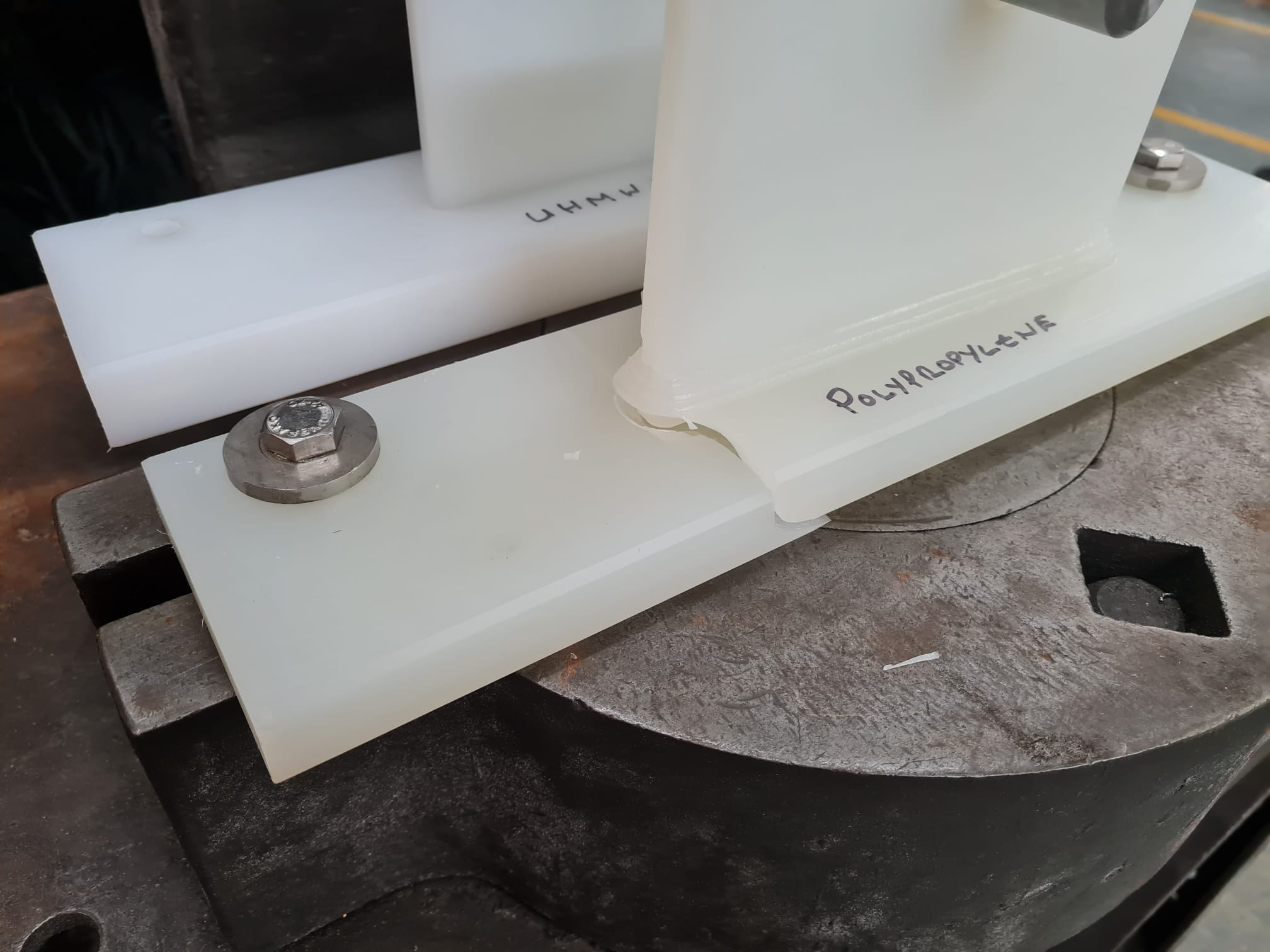
The video above is a split-screen pull test: one PP test piece and one Eagle PE1000 test piece. Each test piece consists of two separate pieces joined together — so the test evaluates both the material itself under load and the joint holding the two pieces. Identical force, same mounting point. The PP fractures cleanly. The PE1000 deflects — and holds. The three photographs below are close-up documentation of the PE1000 test piece after the test was complete.
What you see in those photos is not a near-failure. It is PE1000 behaving exactly as the material is engineered to behave: absorbing energy through deformation rather than releasing it through fracture. Understanding why that happens — at the molecular level — is why the specification decision between PP and PE1000 is not a matter of preference or price. It is a materials engineering choice with documented, measurable consequences.
Why Polypropylene Breaks
Polypropylene is a semi-crystalline thermoplastic with a molecular weight in the range of 100,000 to 500,000 grams per mole. Its polymer chains are relatively short and arranged in a partially ordered crystalline structure. That crystallinity makes PP rigid and dimensionally stable at room temperature, but it also means that under concentrated load — especially at stress risers like holes, joints, and corners — the crystalline structure has no mechanism to redistribute energy. The stress propagates as a crack, and the crack runs.
The PP fracture in the video happens at the weakest structural point under load. Once crack initiation occurs, the geometry concentrates stress ahead of the crack tip faster than the material can absorb it. In a drop scenario, this happens in milliseconds. In a sustained tensile pull at a mounting hole, it propagates slightly more slowly — but the outcome is the same. The material does not have the molecular architecture to translate concentrated stress into distributed deformation.
Why PE1000 Deflects Instead
UHMW PE1000 — Ultra High Molecular Weight Polyethylene — has a molecular weight in the range of 3.5 to 10 million grams per mole. That is roughly 20 to 100 times higher than polypropylene. The critical consequence of that difference is not hardness or surface properties. It is molecular entanglement.
At PE1000's molecular weight, the polymer chains are long enough to physically interlock and weave around each other the way individual fibers in a rope interlock — not through chemical bonding, but through topological constraint. When concentrated force is applied, that entanglement network redistributes stress across millions of contact points simultaneously. No single chain has to carry enough load to fracture. Instead, the network deforms: chains slide against each other, the material thins and stretches locally, and the geometry changes without catastrophic failure.
This is the mechanism behind every observation in the three photographs below. Not material strength in the conventional sense — tensile strength numbers for PE1000 are not dramatically higher than PP. It is energy absorption through distributed deformation that PP's shorter, less-entangled chains simply cannot replicate.
The Joint Never Failed
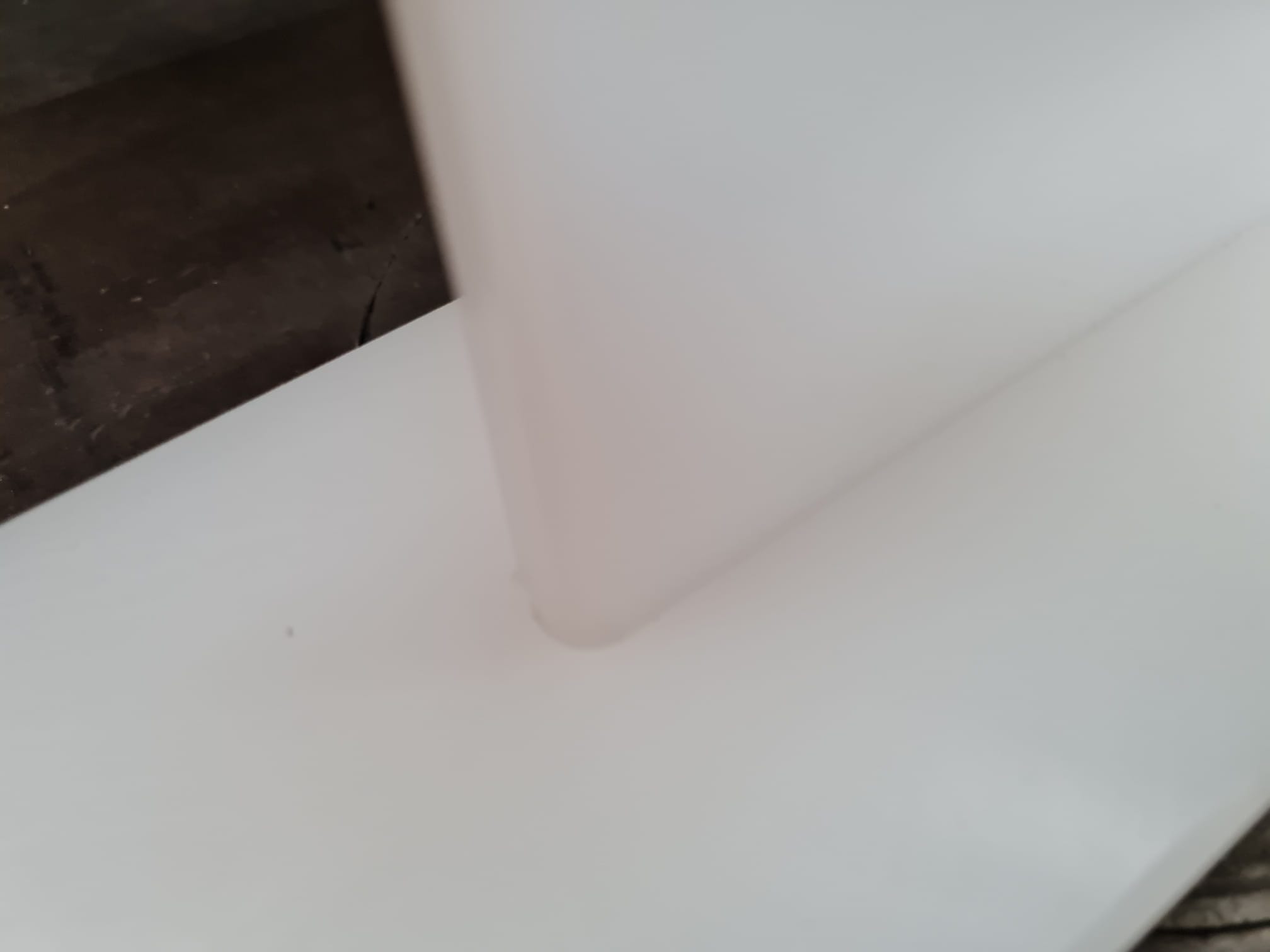
In most PP barrel designs, the joint is the structural failure point under tensile or impact load. The welded or thermoformed joint in a PP barrel concentrates stress at the interface between the body panels, and that interface fractures before the surrounding material reaches its yield point. You see this in the field as cracked end caps, split seams, and barrel doors that lose their retention because the hinge joint failed, not the door panel itself.
Eagle Engineering's Double Lock joint is a proprietary geometry designed so that the PE1000 material on both sides of the joint reaches deformation before the joint boundary does. In the test documented above, the joint is intact. The material adjacent to it shows the deformation. That is the joint doing exactly what it was designed to do: distributing load into the surrounding material so the joint boundary never becomes the point of highest stress concentration.
2.5 cm of Deflection — Not Failure
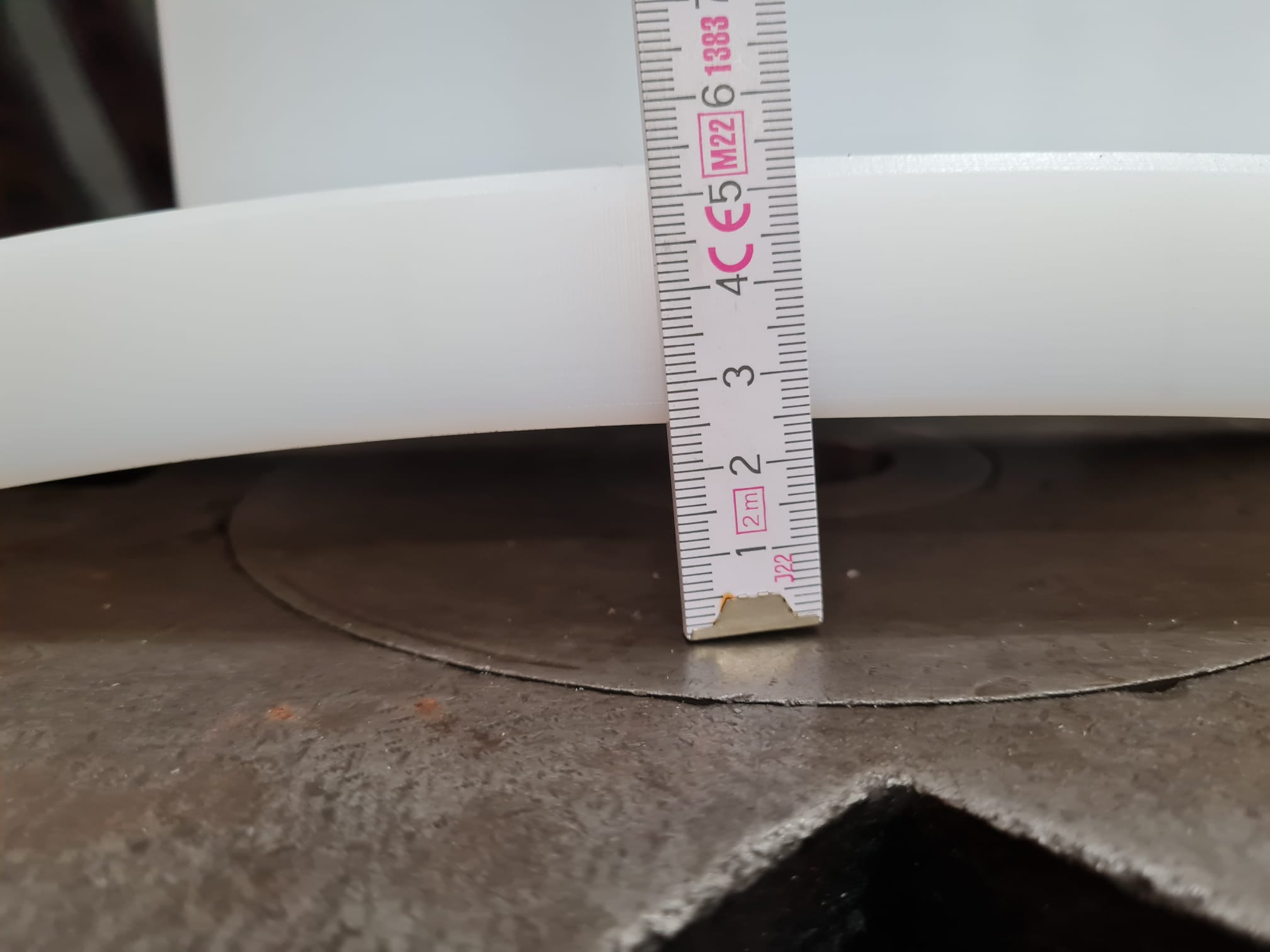
The 2.5 cm deflection shown in the photograph is the result of the molecular entanglement network doing its job under sustained load. PE1000's elongation at break is in the range of 200 to 400 percent — the material can stretch to several times its original dimension before a chain fractures. Polypropylene's elongation at break is typically 10 to 30 percent. That gap is not a minor difference. It is the difference between PE1000 material that absorbs an impact or overload event and holds, and PP that fractures on contact.
The 2.5 cm reading is permanent deformation — the test piece does not spring back to its original geometry after load is released. But permanent deformation without structural breach is a fundamentally different failure mode than fracture. In a production barrel, permanent deformation may affect perforation alignment or door seating. A fractured barrel comes off the line immediately. The distinction matters in an operating environment where a dropped barrel or an off-angle press fit during loading is the difference between a schedule interruption and a production halt.
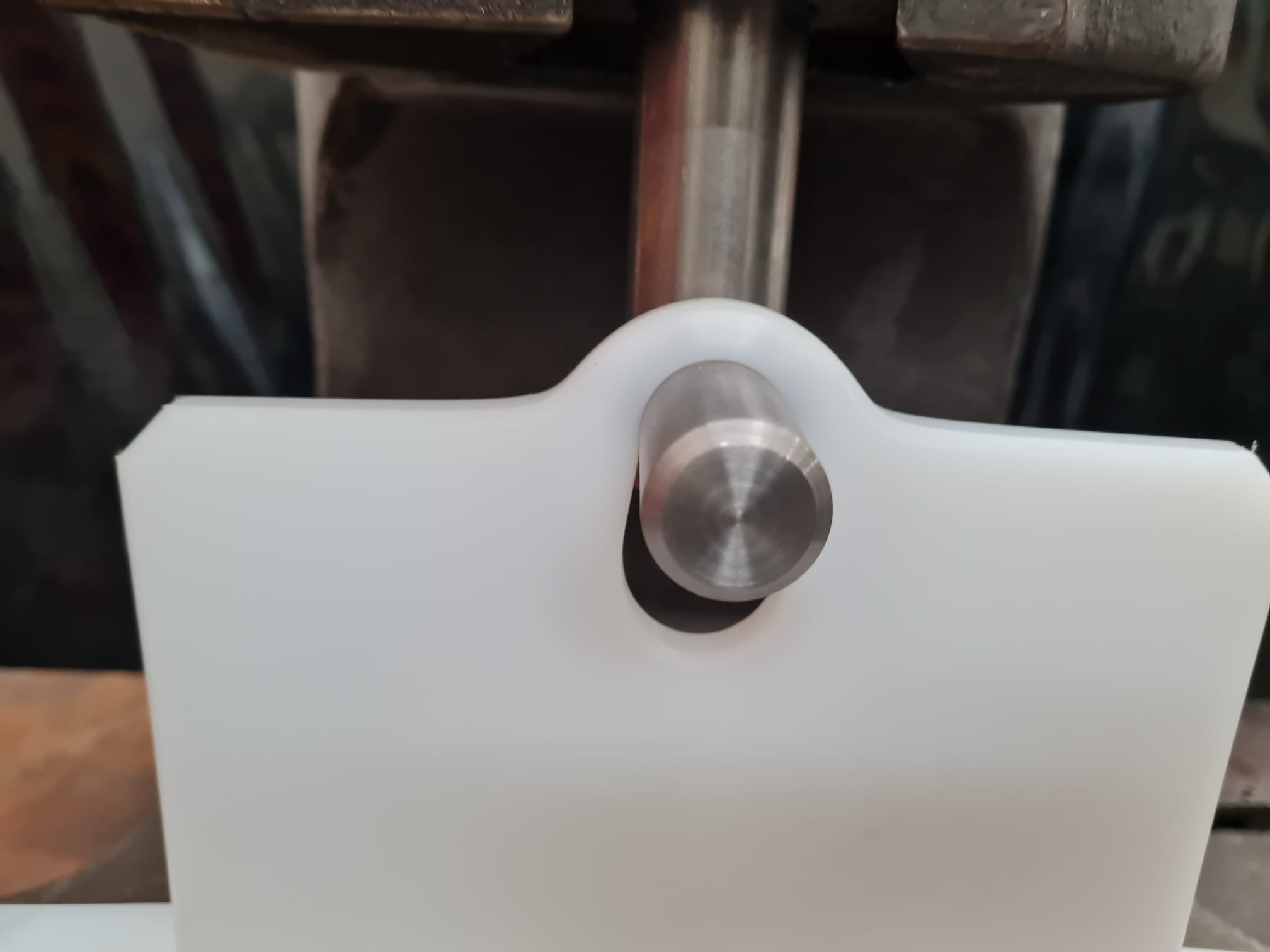
The Hole Went With the Force — It Did Not Crack
Holes under tensile load are a classic stress concentration scenario. In linear elastic fracture mechanics, the stress at the edge of a circular hole in a uniaxial tension field is three times the nominal applied stress — a stress concentration factor of 3.0. In a material with poor crack-initiation resistance like PP, that factor is enough to start a crack propagating from the hole edge under loads that would not fracture the surrounding material. This is why PP barrel end plates crack at the hinge pin holes, at the door latch recesses, and at any penetration under repeated load.
In PE1000, the molecular entanglement network absorbs that concentrated stress at the hole boundary through local yielding. The material adjacent to the hole deforms — visibly, as you can see in the photograph — but no crack initiates. The hole geometry changes slightly as the PE1000 flows under the applied load, but the structural integrity is maintained. The material "went with the force," as the test observation puts it, rather than resisting it brittlely and fracturing at the boundary.
This behavior is directly relevant to every hole, slot, axle bore, and hinge point in a plating barrel. Every one of those features is a stress concentrator. In a PP barrel, each one is a potential initiation point for a failure crack. In a PE1000 barrel, each one has a molecular network behind it that can absorb the stress and deform without fracturing.
What This Means on the Plating Floor
The practical consequence of this material science is not theoretical. It shows up in service life. A PP barrel that sees a drop, an off-angle press fit during loading, or sustained side load from a bent hanger arm will crack — often at the joint, at a hinge hole, or at a door latch point — because those are the stress concentrators in the system and PP has no mechanism to distribute the load away from them. The crack may not be visible immediately. It may propagate slowly over weeks of service, showing up as drag-out chemistry in the wrong tanks, contamination, or current distribution problems before anyone finds the crack itself.
A PE1000 barrel in the same scenario deforms. The deformation may be visible — a slightly bowed wall, a door that seats differently — but the structure does not breach. There is no entry point for chemistry. Current distribution is maintained. The barrel may need inspection and replacement at the next scheduled maintenance, but it does not fail mid-run.
Eagle Engineering builds every barrel from PE1000 precisely because this behavior is not an accident of material choice. It is the reason a 20-year-old Eagle barrel is still running on an active UK production line with its perforations intact and its joints closed. The molecular architecture of the material is the service life of the barrel.
If you're evaluating PP vs. PE1000 for a new barrel project or a line upgrade, Jim can walk through the specific application with you — part geometry, bath chemistry, load weight, and service-life expectations — and give you a concrete recommendation. Every Eagle barrel project starts with that conversation.
Talk Through a Barrel Project →