
pH, ORP, and Amp Hours: The Three Numbers
Why These Three
Among the many parameters that influence zinc plating quality, pH, ORP, and amp hours have the highest impact-to-monitoring-cost ratio. They're measurable in real time with standard instrumentation, highly predictive of deposit quality, and when logged systematically, they give you a complete diagnostic record of every production run. If you can only instrument three things on your zinc line, instrument these.
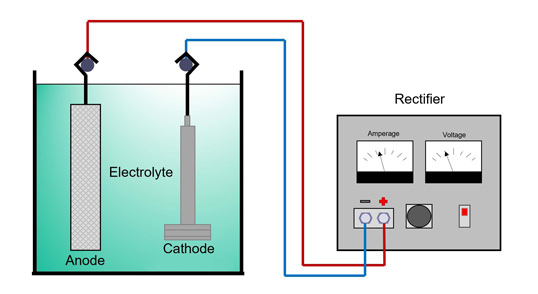

pH
In alkaline zinc plating, bath alkalinity governs the availability of the zincate ion and the rate of hydrogen evolution at the cathode. Alkaline zinc baths operate at strongly alkaline conditions — NaOH concentrations that exceed the reliable measurement range of standard glass pH electrodes (typically unreliable above ~pH 13). In practice, bath chemistry is controlled by NaOH concentration verified by acid titration, not a direct pH meter reading. (The pH values of 12.0–13.5 cited in some technical literature reflect diluted-sample measurements, not direct readings of the bath.) When alkalinity runs too high, hydrogen evolution increases, producing duller deposits with higher internal stress. When it runs too low, you risk anomalous dissolution behavior and adhesion issues on certain substrates. Verify the correct NaOH titration target and test method with your chemistry supplier — it varies by formulation.
Bath alkalinity is the easiest of the three parameters to monitor and the one most frequently neglected. A quality titration kit checked twice per shift catches most drift before it becomes a reject problem. An in-line caustic dosing controller with conductivity feedback eliminates drift entirely and pays for itself quickly in high-volume operations. See 6 Signs Your Zinc Bath Is Out of Spec for the deposit quality indicators that pH drift produces.
ORP (Oxidation-Reduction Potential)
ORP measures the electrochemical potential of the bath — its tendency to oxidize or reduce dissolved species. In zinc finishing, ORP is most critical in post-plate treatments: trivalent chromium passivate baths are controlled primarily by ORP. Maintaining the correct ORP range (which varies by passivate formulation — consult your chemistry supplier for your specific system) is what produces consistent passivate layer color, thickness, and corrosion performance. ORP that drifts out of range produces color variation and reduced salt spray performance, often before any other parameter shows a problem.
In the zinc plating bath itself, ORP monitoring is a useful secondary indicator for contamination events. A probe reading that shifts meaningfully without a corresponding production change is worth investigating. Becker Engineered Systems' chemical feed controllers can automate ORP-based dosing to keep passivate baths in specification without manual intervention.
Amp Hours
Amp hours — the time-integral of current — governs the mass of zinc deposited via Faraday's law. Zinc is a divalent metal, so each mole of zinc deposited requires 2 Faradays of charge (approximately 192,970 coulombs). In practice, amp-hour totalizers allow you to target a specific deposit thickness by running a known number of amp hours per load at a known current efficiency.
If you log amp hours per load and track deposit thickness, you can dial in your process to hit specification thickness consistently — and detect bath efficiency changes before they produce rejects. A totalizer showing the same amp hours but thinner deposits signals a drop in bath current efficiency: check zinc metal concentration, temperature, and anode condition. See Choosing the Right Rectifier for how rectifier output quality affects deposit efficiency and amp-hour accuracy.
Building a Process Log
The real value of these three measurements isn't individual readings — it's the trend log. A one-page daily process log with pH, ORP, and amp-hours-per-shift takes five minutes to maintain and creates a diagnostic record that makes every future reject investigation faster and more accurate. Operations that log this data consistently can typically diagnose a reject spike in hours. Operations that don't log it can take days, or never find the root cause.
Start with paper logs. Migrate to a digital system if volume justifies it. The habit is more important than the format.
AquaPhoenix supports testing resources and chemical feed/control equipment, while Becker supports treatment-side monitoring and management. Tell us what you are measuring now and Jim can help identify the next practical control point.
Ask About Testing & Feed Control →