C-Slot vs. Round Hole vs. Straight Slot: Choosing the Right Barrel Perforation
Why Perforation Type Is One of the Most Important Barrel Decisions
The perforations in a plating barrel govern everything that moves between the bath and the parts inside: current, electrolyte, heat, and drag-out solution. Open area percentage determines how efficiently current reaches the parts, how quickly solution exchanges during immersion and drain cycles, and how much chemistry gets carried between tanks.
Eagle Engineering offers three perforation types, each machine-cut (not punched) from PE1000 UHMW material. The choice between them depends on your part geometry, chemistry, and what you're optimizing for.
Option 1: Round Hole (Internally Countersunk)
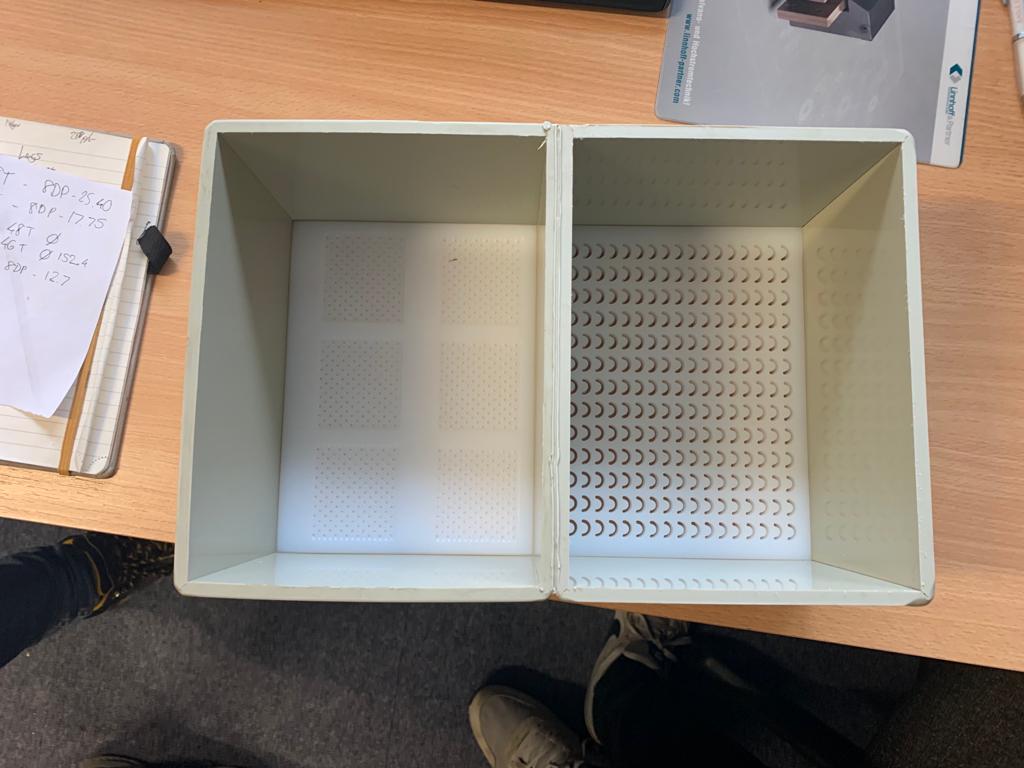
The traditional perforation type. Each hole is drilled and internally countersunk to protect from impact damage on the inside surface. The countersink also helps solution transfer by creating a funnel effect during drainage. PE1000's remarkable resistance to hole closure means round perforations maintain their geometry far longer than in PP barrels, where holes gradually deform and close under sustained thermal and mechanical load.
Typical specification: 1.5-2.2mm holes with internal countersink. Open area varies by spacing pattern but typically ranges from 10-15% of panel area. On fine-pitch patterns (e.g., 1.5mm countersunk on 4mm x 4mm pitch), PE1000's tensile strength allows higher perforation density — Eagle barrels can achieve up to 40% open area on standard barrels and up to 45% on specialty configurations. Perforation chamfers and corrugation patterns are also available to further eliminate surface tension and product adhesion.
Best for: General-purpose plating where part geometry doesn't create entrapment risk. Round holes are the simplest to specify and the baseline against which other perforation types are compared.
Limitation: Lower total open area compared to slot-based designs. In one documented comparison, round holes at 2.0mm achieved approximately 11% open area versus 26% for C-Slots at the same nominal dimension — a 131% difference.
Option 2: C-Slot (Curved Slot with External Counterbore)
Eagle's C-Slot design is a curved slot that's larger on the external face and smaller on the internal face. The external counterbore creates an active pumping effect — as the barrel revolves, fresh solution is forced through the counterbore and pumped into the barrel interior. The curved geometry allows significantly more open area per perforation than a round hole while maintaining the smaller internal opening that prevents part entrapment. The internal slot has a V-profile that protects against impact damage and closure, decreases wear, and drastically reduces solution drag-out.
Documented performance (from customer testing):
| Metric | 2mm Round Hole | 2mm C-Slot |
|---|---|---|
| Open area per perforation | 3.14 mm² | 28.27 mm² |
| Perforations per panel | 858 | 221 |
| Total open area per panel | 2,695 mm² (~11%) | 6,249 mm² (~26%) |
| Fill time | 4 seconds | 2 seconds |
| Drain time | 3 seconds | 1 second |
Best for: Most barrel plating applications. The C-Slot is Eagle's most popular perforation type because it delivers the best combination of open area, solution transfer speed, and part retention. Particularly valuable in operations where drag-out reduction and energy savings are priorities — the 131% open area increase translates directly to lower rectifier voltage requirements.
Energy impact: One customer documented $247.88 per barrel per year in energy savings after switching from round hole to C-Slot — $11,898 per year across a 48-barrel line. See the full case study for the complete analysis.
C-Slot in Action — Sink and Drain Tests
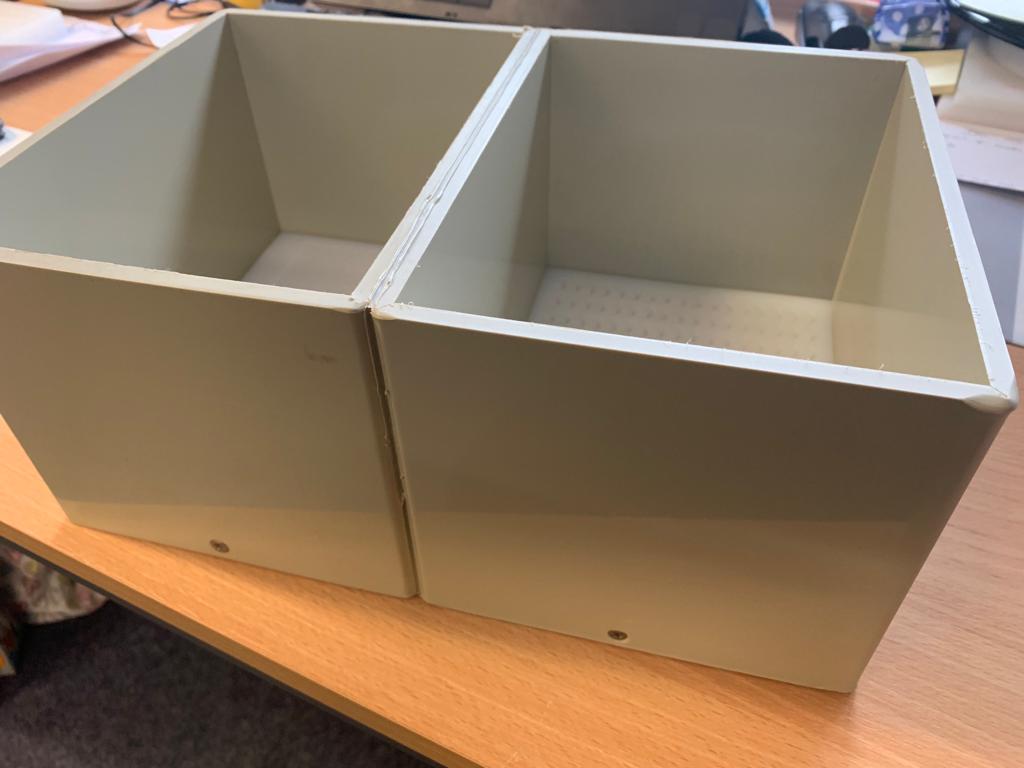
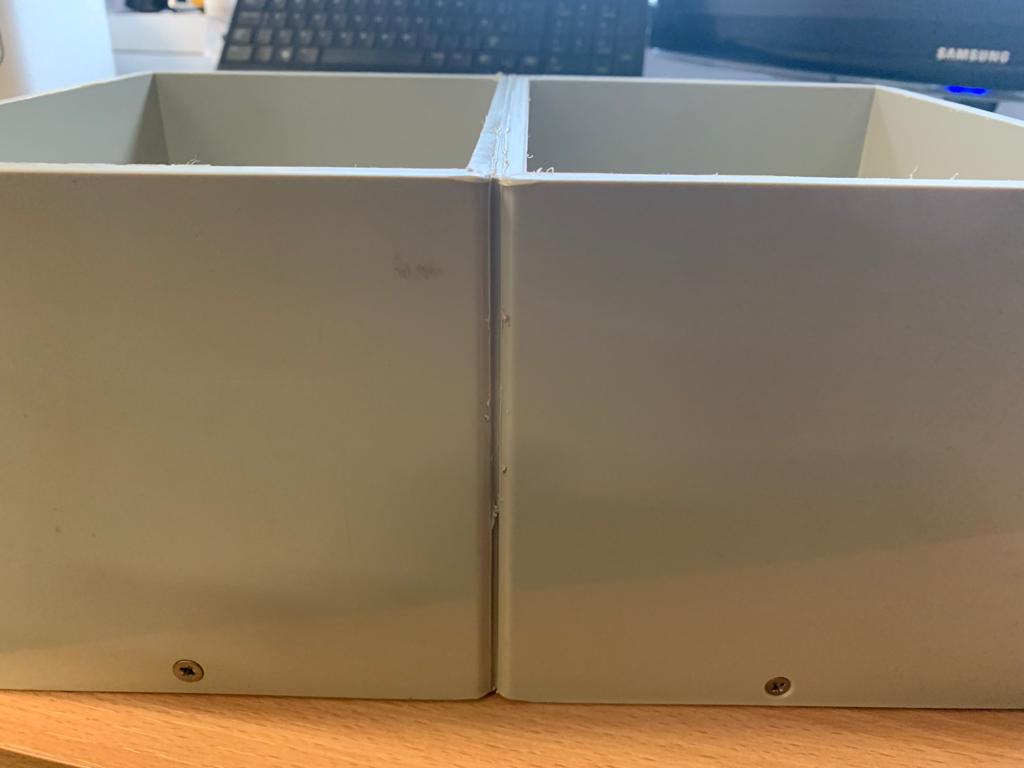
The speed difference between C-Slot and round-hole perforations is immediately visible when you watch solution enter and leave the barrel. These tests were conducted with a demonstration barrel — watch how quickly the C-Slot panels transfer solution compared to the standard round holes on the left:
Option 3: Straight Slot (External Counter-bore with Internal V-Profile)
Straight slots use an external counter-bore for faster solution transfer and an internal V-profile to protect against impact damage and perforation closure. The geometry provides high open area with good mechanical protection.
Best for: Applications requiring very high open area where the part geometry works with linear slot orientation. Some part shapes interact differently with straight slots versus curved slots — Eagle can advise based on your specific parts.
Specialty: Coin Barrel Perforations
For coin and medallion plating, Eagle uses 12mm perforations in a standard matrix pattern achieving 42% open area — nearly double the open area of standard barrel perforations. The larger perforations are possible because coin barrels don't need to retain small parts. Combined with a textured internal surface (to prevent coin adhesion from surface tension) and Eagle's sinusoidal wave lid profile (to eliminate coin entrapment at the barrel door), the coin barrel is a purpose-built solution for currency and medallion manufacturers.
The Material Factor: Why Perforation Type and Barrel Material Are Linked
Perforation performance over time depends on the barrel material holding its geometry. This is where PE1000 and polypropylene diverge significantly. PP barrels experience creep — gradual permanent deformation under thermal and mechanical load — which narrows perforations and reduces effective open area over 12-24 months of service.
PE1000, with a relative abrasion rating of 100 versus PP's 750 (7.5x better), resists this creep. In a 6-month head-to-head test at a major German facility, PP barrel perforations deformed and began closing while Eagle PE1000 perforations remained at specification. This is why the open area advantage of C-Slots is sustained across the full barrel service life in PE1000 — and gradually lost in PP.
Eagle barrels at one facility have maintained perforation geometry for 20+ years of continuous operation on a 24/6 schedule. See PE1000 vs. Standard Polypropylene for the complete material comparison.
How to Choose
For most barrel zinc plating operations, C-Slot is the recommended starting point. It delivers the highest open area, fastest solution transfer, and best energy economics. Round holes are appropriate when a simpler perforation pattern is adequate and the open area trade-off is acceptable. Straight slots suit specific part geometries and high-open-area requirements.
Eagle's engineering team will recommend the optimal perforation type based on your part geometry, chemistry, and production requirements. Custom perforation sizes are available — the standard 2mm dimension can be adjusted to suit specific part retention needs.
Not sure which perforation type is right for your application? Send us your part geometry, chemistry type, and what you're trying to optimize — we'll recommend the right perforation design and model the expected performance improvement.
Request a Perforation Recommendation →