
How to Spec a Replacement Barrel: A Field Measurement Checklist for the Existing Line
Why Replacement Barrels Are Harder to Spec Than New Lines
A new plating line is, paradoxically, easier to specify than a replacement barrel set. On a new line, every component is being designed together — gears, hangers, drive system, and barrels are all engineered to work as a system. The plating supplier provides drawings for the entire installation, and dimensions are coordinated at design time.
A replacement barrel project is the opposite. The customer is keeping the existing line — the gears, hangers, drive system, bus bars, and bearings are all already installed and working. The new barrel has to drop in and match the existing equipment exactly. A 1mm error on a gear bore means the barrel doesn't turn. A 5mm error on a bearing through-hole means the dangler cable doesn't fit. Careful measurement at the front end saves rework on the back end.
This article walks through the six dimensional families that have to match, what specifically to measure on each, and the common errors that turn a routine replacement into a multi-week rework loop.
The Six Dimensional Decisions
A replacement barrel is fully specified by measurements in six families: (1) barrel body dimensions, (2) main gear specs, (3) drive gear / pinion specs and center distance, (4) hanger/yoke spacing and trunnion pin diameter, (5) bearing specs including through-hole diameter, and (6) bus bar / cathode connection method. Get all six right and the new barrel drops into the line with zero modification. Miss any of them and the line stops while custom adapters are fabricated.
1. Barrel Body — Diameter and Length
The two primary barrel body measurements are diameter (outside the body, not including end heads or door clips) and length (end-to-end of the cylindrical body, not including the end heads or hangers). Standard Eagle barrel sizes for North American plating include 14×30, 14×36, 16×36, 18×36, 18×48, 18×60, 18×80, 20×48, and 24×60 (all in inches). If your existing barrel is within 0.5" of one of these standard sizes, the replacement uses the standard specification. If it's between standard sizes, Eagle can build to custom dimensions but lead time extends.
To measure: with the barrel removed from the line and resting on a workbench, use a tape measure across the outside of the cylindrical body at the center (avoid measuring across end heads or doors). For length, measure end head to end head along the barrel axis. Record both dimensions in inches and millimeters — Eagle works in metric but quotes are cross-checked in imperial.
The wall thickness is also measurable but less critical for replacement. Eagle's standard PE1000 barrels are 12mm or 16mm wall depending on diameter. If the existing barrel has a non-standard wall thickness, it's usually because the original was a competitor product (Koch, Jessup, Hardwood Line) — note this and let our team know. Wall thickness affects bearing seat depths and end head fit.
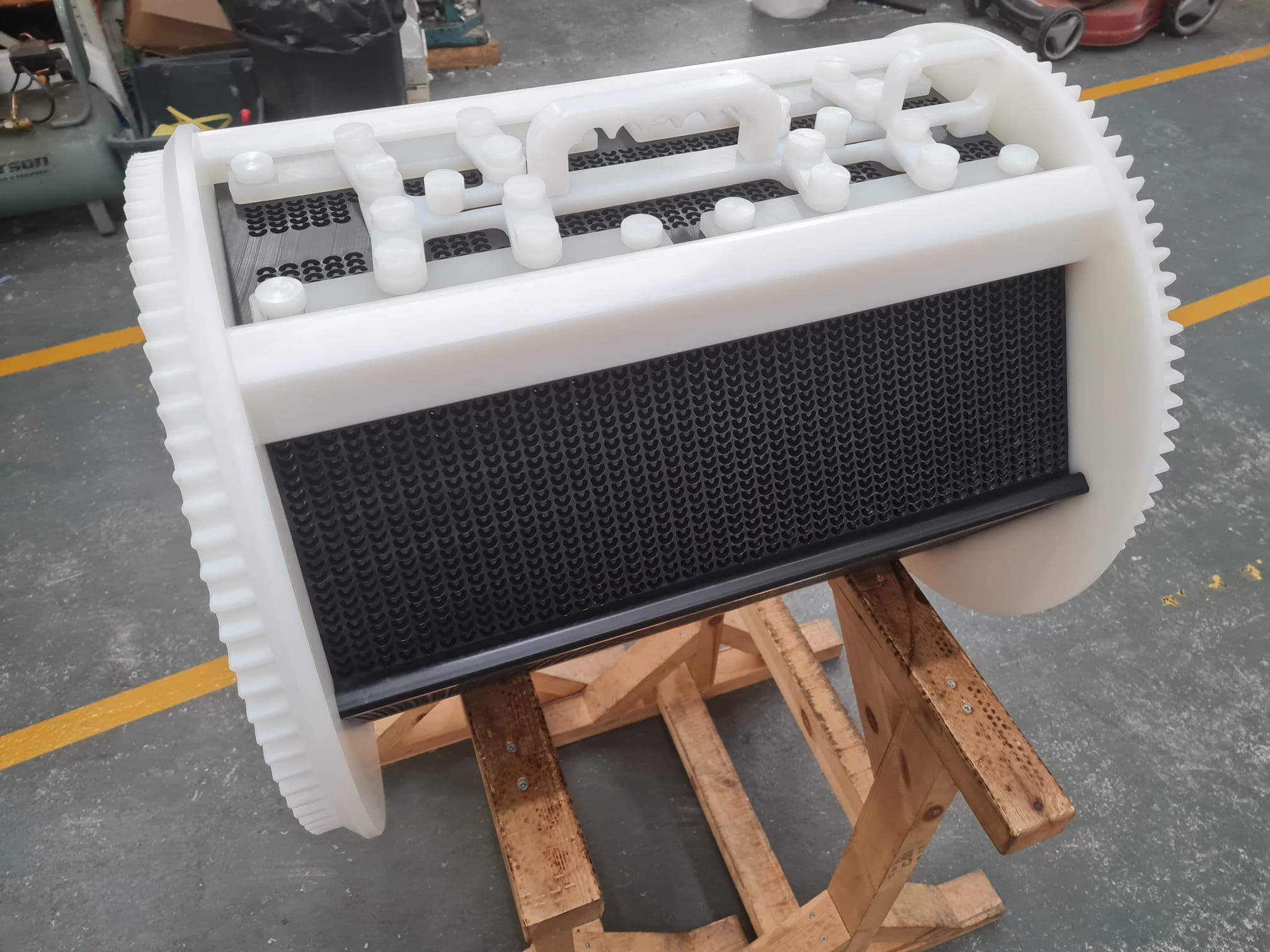
2. Main Gear — Tooth Count, Bore, Diameter
The main gear (sometimes called the "barrel gear" or "ring gear") is the gear visible at one or both ends of the barrel that meshes with the line's drive system. For replacement work, you need three measurements:
Tooth count — count the teeth around the gear. Common counts are 60, 72, 75, 80, 90, and 96 teeth. The count itself is a primary spec; the count and diameter together determine the gear "module" or DP (diametral pitch). Outer diameter (OD) — measure across the gear from tooth tip to tooth tip on opposite sides. Common diameters are 18", 21.5", and 24". Bore (ID) — measure the diameter of the central hole where the gear mounts to the barrel end. The bore has to match the barrel end head exactly or the gear can't be fitted.
One additional spec: gear thickness. Measure the axial thickness of the gear (along the rotation axis). This determines the depth of the gear seat machined into the barrel end head. Eagle's standard gear thicknesses are 25mm and 38mm.
If you're keeping the existing gears (which is usual on replacement projects), the new barrels must accommodate them. Eagle will design the end heads to match the gear ID, OD, thickness, and tooth count provided.
3. Drive Gear / Pinion — Specs and Center Distance
The drive gear (or pinion) is the smaller gear on the line's drive shaft that meshes with the barrel's main gear. For replacement work, the critical measurement isn't usually the drive gear itself — that's already installed and working — but the center-to-center distance between the drive shaft and the barrel rotation axis. This distance, combined with the OD of both gears, determines whether they mesh properly.
To measure center distance: with the line stationary, measure from the center of the drive shaft to the center of the barrel trunnion pin (the rotation axis of the barrel). This is most easily done by measuring from a reference point on the line frame to each axis and computing the difference.
If the new barrel's main gear OD matches the existing one, the center distance is automatically correct. If the OD changes, the drive system has to be re-positioned — which means a structural modification to the line, not just a barrel swap.
4. Hanger / Yoke — Spacing and Trunnion Pin Diameter
The hangers (or yokes) are the brackets that suspend the barrel in the bath. Each hanger has a hole or bushing through which the barrel's trunnion pin passes, allowing the barrel to rotate. Three measurements matter:
Hanger spacing — the center-to-center distance between the two hangers, which equals the overall length of the barrel including its trunnion pins. Trunnion pin diameter — the diameter of the cylindrical pin extending from each barrel end head into the hanger bushing. Common diameters are 35mm, 42mm, and 50mm. Hanger material — note whether the hangers are steel, stainless, or coated; this matters for bath compatibility but doesn't affect barrel dimensions.
To measure hanger spacing: with the existing barrel removed, measure from the inside face of one hanger to the inside face of the other, in line with the barrel axis. To measure trunnion pin diameter: use a caliper on the existing barrel's trunnion pin, or measure the inside diameter of the hanger bushing.
5. Bearings — Through-Hole Diameter and Material
Each barrel end head contains a bearing that supports the trunnion pin. For lines with internal cathode danglers — where the dangler cable enters through the bearing into the barrel interior — the bearing through-hole diameter is the most critical replacement measurement.
Eagle's standard PUR 120mm² dangler cable requires a 30mm (1.18") through-hole. If the existing bearing has a smaller through-hole — common on older lines designed for 70mm² PVC cable, which only needs 24mm — the bearing has to be bored out to accept the larger cable. This is a routine field modification but it has to be planned and quoted, not discovered during installation.
To measure: pull a bearing from a barrel end head if possible, or measure the inside diameter of the dangler pass-through hole at the bearing location. Note both the bearing through-hole diameter and the bearing outer diameter (which has to match the seat in the barrel end head).
Bearing material is also relevant. Eagle's standard bearings are PE1000 or UHMW polyethylene. Some older lines use bronze or ceramic bearings. The replacement barrel can use any of these, but the choice affects friction, wear life, and bath compatibility.
6. Bus Bar / Cathode Connection Method
The final dimensional family is how electrical current enters the barrel. Three methods are common:
Dangler cable through bearing — current enters via a flexible cable passing through the bearing into the barrel interior, where it terminates at a contact tip. Most modern lines use this method. Direct contact via gear or hanger — current enters through the rotating gear or the trunnion pin via a brush or sliding contact. Older lines and some specialty applications use this. Other — bus bar configurations exist that don't fit either category, especially on older custom-built lines.
For dangler-fed lines, also note: the bus bar bolt size that secures the dangler lug (M10/M12/M16 — see the bus bar bolt identification article), the number of danglers per barrel (1, 2, or 4 are common), and the dangler entry side(s) — left, right, or both.
The 30-Minute Field Walk
If you can spend 30 minutes at the line with a tape measure, calipers, and a notebook, here is the complete sequence to capture everything Eagle needs to quote a replacement: (1) Barrel body diameter and length. (2) Main gear OD, tooth count, bore, and thickness. (3) Drive gear center-to-center distance to the barrel axis. (4) Hanger center-to-center spacing and trunnion pin diameter. (5) Bearing through-hole diameter. (6) Bus bar bolt size and number of danglers per barrel. (7) Photos: full line view, single barrel side view, end head close-up, gear close-up, hanger detail, bearing/cable entry detail.
What to Bring to the Quote Conversation
Once you have the measurements, send them as a single, consolidated submission rather than dribbling dimensions through several emails. Use the contact page on this site, or email info@levelupplatingsupply.com, with all six dimensional families above plus a few photos. The more complete the first submission, the fewer rounds of clarification on the way to a drawing.
If your line is older than about 25 years and you don't have any source drawings, it's worth a phone call before you measure. We can talk through the inspection sequence and help you identify the original manufacturer (Koch, Jessup, Hardwood Line, etc.) — which often unlocks reference dimensions from existing records.
Replacing barrels but keeping the line? Reach out before you start measuring — a short conversation can flag any non-standard components that need attention. Use the contact page or email info@levelupplatingsupply.com.
Get in Touch →